casasmooth starts by showing you where every watt goes. Then it lets you set simple rules, appliance by appliance. Then an optimiser plans around your needs, never against them. And the same logic scales to a whole building, then to neighbours sharing their production. This page follows that order, from the simplest to the most advanced.
01 · The simplest
See where every watt goes, live
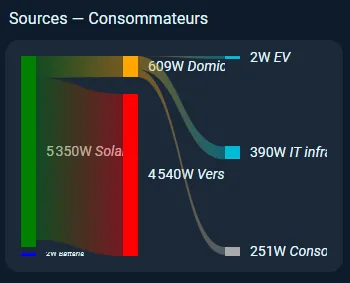
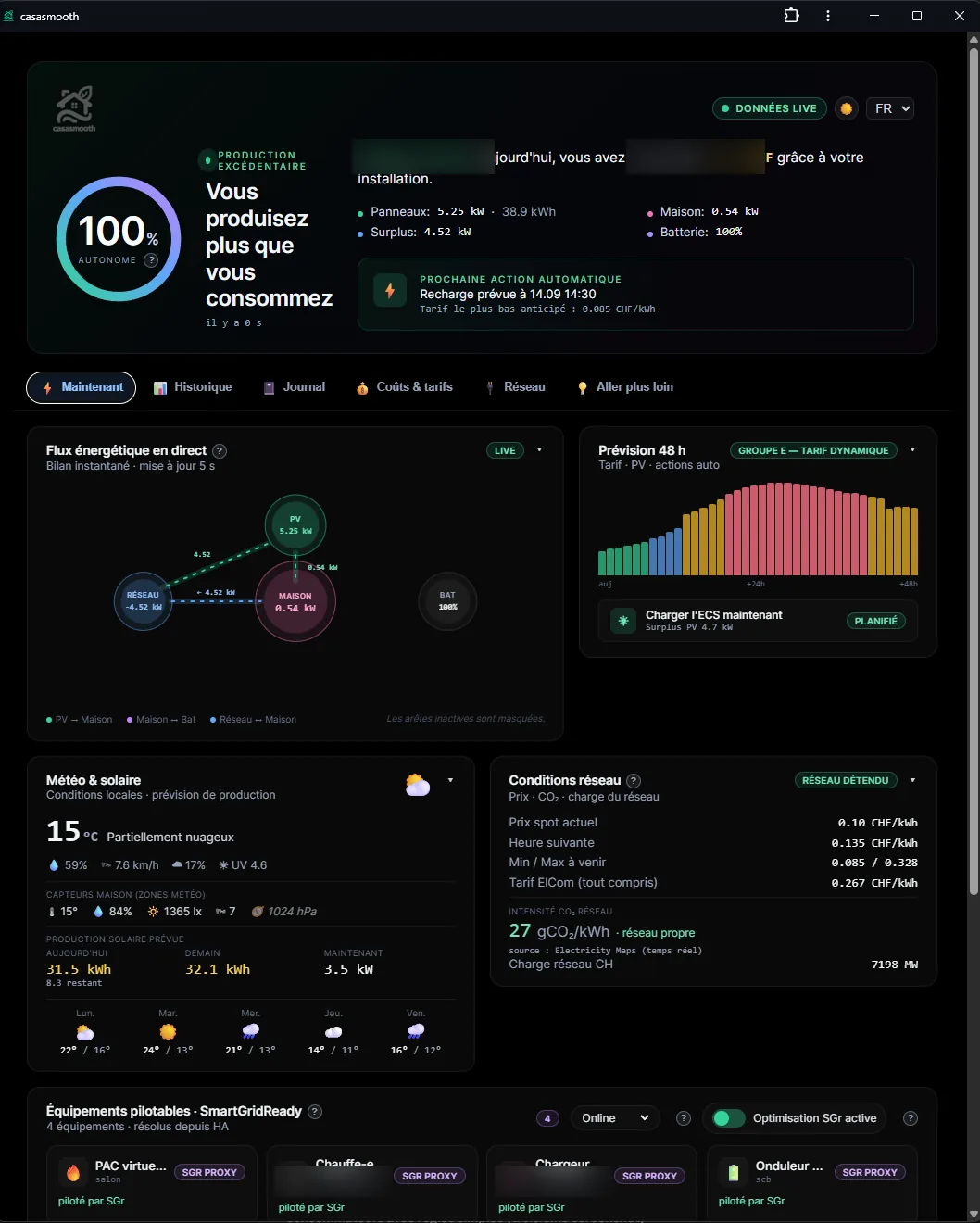
Before controlling anything, you need to understand. The energy view of the hub shows the live balance between the roof, the house, the battery and the grid, and the flow diagram details which appliance uses what. These are two charts among the many the app offers: this page only shows a selection.
A live balance, refreshed every five seconds: production, house consumption, surplus, battery state and the direction of the exchange with the grid.
A flow diagram from sources to consumers: solar, battery and grid on one side, every measured usage on the other, with its current power.
The next automatic action is announced in plain words, with its time and the expected tariff. Nothing happens behind your back.
The flow diagram: from sources to consumers, appliance by appliance.The “Now” view: live balance, 48-hour forecast, weather and expected production, grid conditions.
02 · Control without programming
Simple rules, appliance by appliance
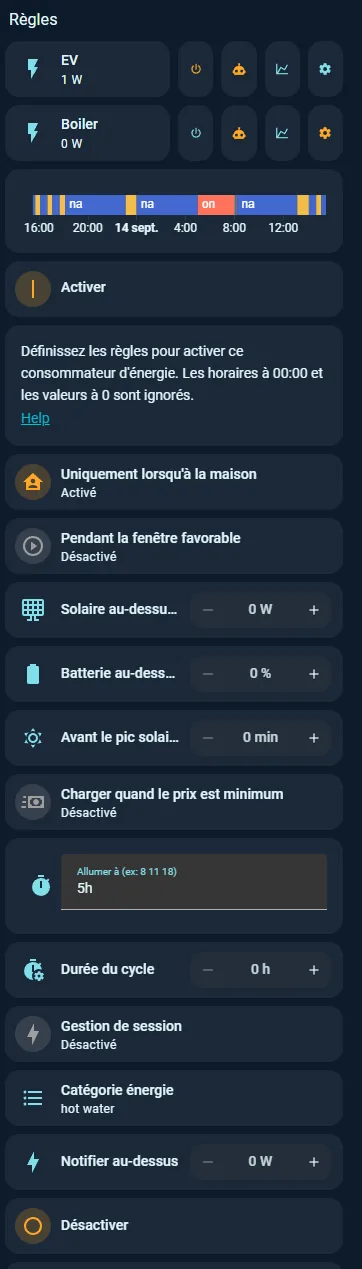
Every controllable consumer, charging station, water heater, heat pump or pool pump, gets its own rules card. Tick a box, move a slider, and the hub takes over. No configuration file.
When to switch on: only when someone is home, during the favourable tariff window, at a fixed time, or when the price hits its daily minimum.
On which energy: solar above a power threshold, battery above a charge level, or a set time before the forecast solar peak.
For how long: a cycle duration, or session management for appliances with a target to reach, such as a car to charge.
What must never happen: never cut an appliance mid-cycle above a given power, and warn you if it draws more than expected.
A manual gesture always wins: if you switch an appliance on by hand, the hub leaves it alone for an hour before its rules resume.
A consumer's rules card: every line is a rule, every rule reads without a manual.
03 · One step further
The optimiser: your needs first, savings second
Simple rules decide appliance by appliance. The optimiser looks at everything at once: forecast solar production over 48 hours, the hour-by-hour tariff, the battery, the car, the water heater, the heat pump. It looks for the cheapest plan that honours everything you declared. Here is what that means in practice.
You say
« This socket must deliver 30 kWh to the car, now »
A charging session with a target is a hard constraint: the station charges right away, without interruption, until the 30 kWh are delivered. The optimiser and the simple rules step back from that appliance for as long as the session lasts, whatever the price does. A session opens by scanning the socket's code, with an email and the kWh: that is also how a guest charges on your station.
You say
« The water heater must run every day »
It will run, at the cheapest hours. And if the plan is recomputed during the day, hours already delivered are not renegotiated. The water never drops below the temperature you set, nor below the sanitary floor.
You say
« Only when we are home »
When you are away, no comfort heated for nobody and no appliance boosted for no one. Daily obligations are paused and resume when you return.
You say
« Do not cut the washing machine mid-cycle »
The automatic rules never cut an appliance drawing above the threshold you chose, and give it a delay after it starts. It is a per-appliance setting, two sliders on its card.
Your needs are hard constraints
The optimiser is not allowed to break them, even if it would be cheaper. It spends all the remaining freedom on saving you money.
The grid comes first
A signal from the grid operator, power limit or blocking window, is honoured as a hard constraint, logged and reversible.
Every decision is explained
The log says who decided what and why: a rule, the optimiser, a grid signal or your own gesture. The quality of decisions is measured, not assumed.
04 · Francs, not only kilowatt-hours
Understand your history and count in francs
Kilowatt-hours convince nobody, francs do. The hub values every kilowatt-hour at the price actually paid, with your supplier's tariff, not a theoretical average.
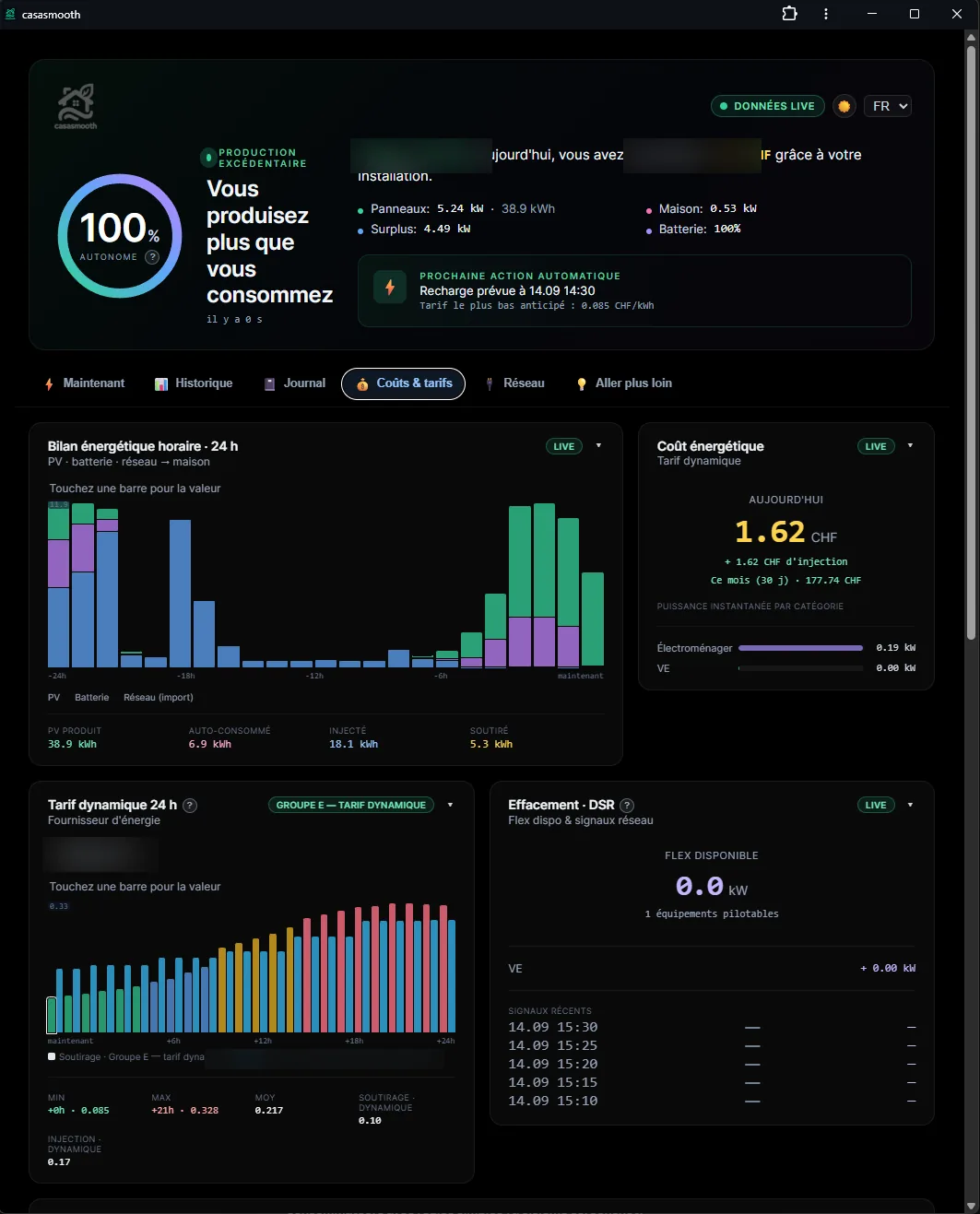
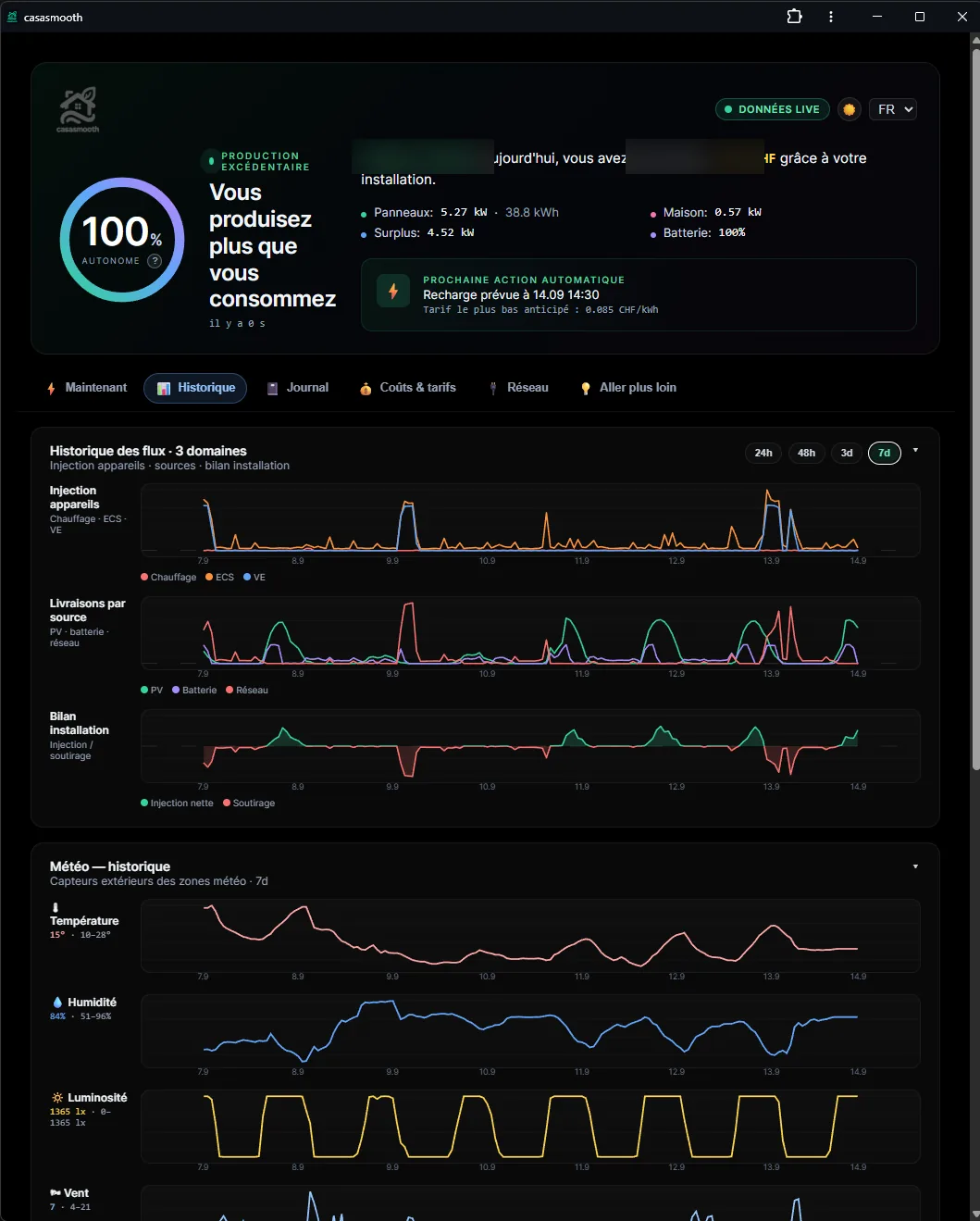
History from 24 hours to 7 days: what each appliance received, from which source, and the export or import balance of the installation.
Today's and this month's cost, broken down by usage: heating, hot water, car, appliances. The sum of usages always equals the real bill.
Your supplier's dynamic tariff, hour by hour over 24 hours, in both directions: the import price and the price paid for your export. This is the price the rules and the optimiser follow, combined with the weather and the solar production forecast: the hub knows what the roof will produce tomorrow before deciding when to consume.
Standby consumption, what the house draws when nobody touches anything, annualised in francs. Often the most striking figure, and it depends on no setting.
What the orchestration earned is read against a reference curve at the average price. If the gap is unfavourable, it is shown too: a tool that never shows a loss is no longer a measurement.
Costs and tariffs: hourly balance, daily and monthly cost by category, the supplier's dynamic tariff, flexibility available to the grid.
History: delivery per appliance, delivery per source, installation balance, with the weather alongside.
05 · The Swiss standard, and beyond
SmartGridready: the grid speaks, the house listens
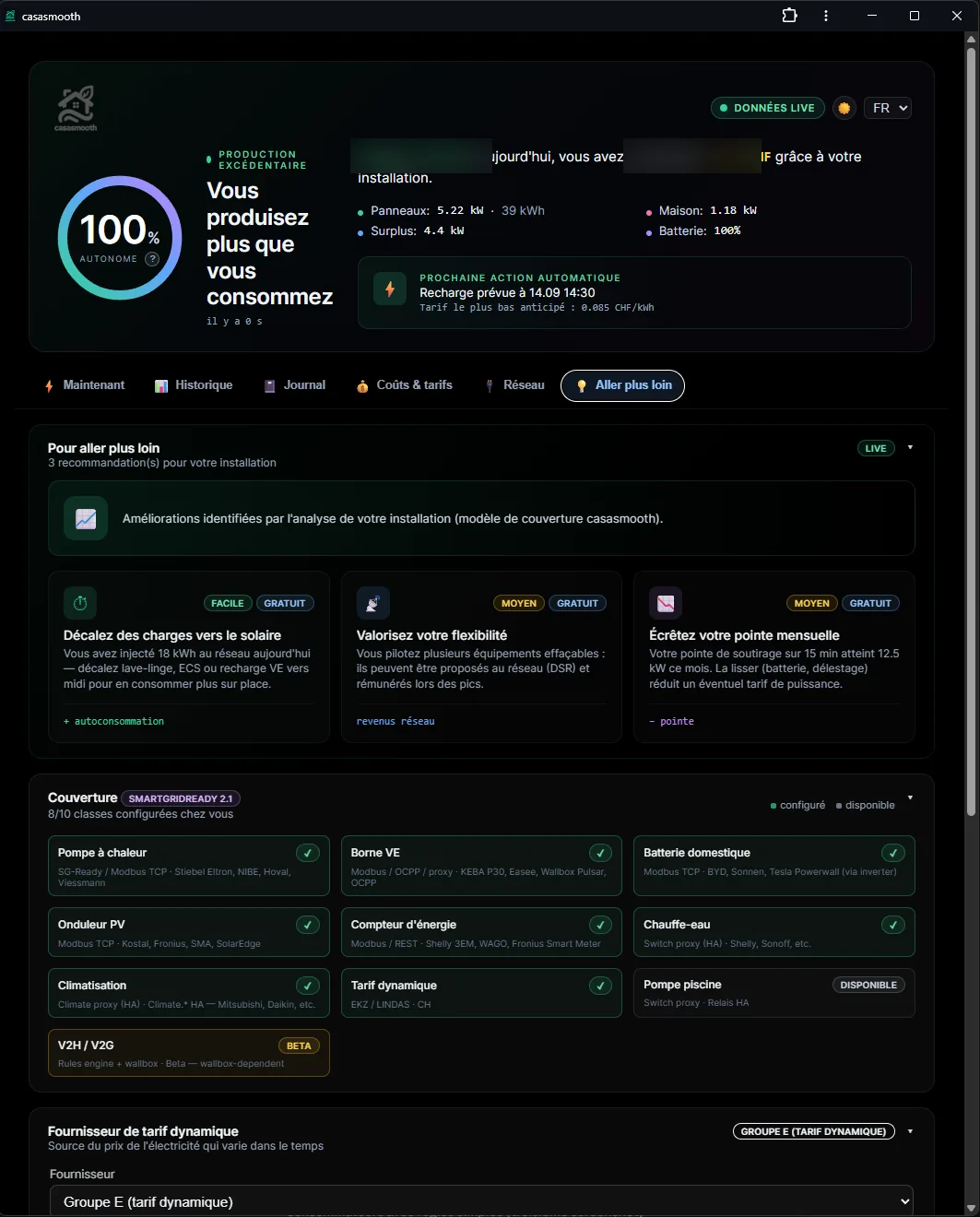
SmartGridready is the Swiss standard that lets an appliance be controlled independently of its manufacturer. The hub keeps the inventory, class by class, and shows what is configured at your place, what is available, and what remains to be done.
Heat pump, charging station, water heater, battery, inverter, meter, dynamic tariff: the SmartGridready device classes are driven with the profiles of the official library.
Existing equipment is not left behind: a relay, a thermostat or an unlabelled water heater gets the same logic through a proxy, and joins the same plan.
Grid operator signals, power limits, blocking windows, are acknowledged, logged and honoured as hard constraints, with a compliance history.
And in Europe
In Germany and Austria, grid-friendly control goes through EEBUS, published as the IEC 63380 standard. The hub ships an EEBUS stack proven against real equipment, without being certified: it cooperates with that control, it does not claim compliance. In France, the topic is the NEBEF demand-response mechanism, a market access rather than a device standard. We say exactly what is done, and nothing more.
The installation's SmartGridready coverage, class by class, and the recommendations to go further.
06 · Beyond the villa
Buildings and topologies: one hub per role
Two installations with the same appliances can have different balances, because the wiring differs. The hub does not guess the wiring: it is declared at commissioning, and the model derives what belongs in the balance. Three common topologies.
Topology 1
The single-family house
One hub, one meter, one roof. Everything described above on this page, with no other role.
Topology 2
The building: one building hub, one hub per unit
The hub in the technical room owns the building meters, runs the optimiser and publishes a live picture: production, surplus, solar share, tariffs. Each unit hub receives only its own share, never a neighbour's.
Topology 3
Off-balance sources
A photovoltaic field feeding the grid directly, a battery shared with another building: they belong to the household without supplying the home. They are shown and controlled, but excluded from the balance, so as not to inflate a self-consumption that does not exist.
A measured index always wins over a computed one, and nothing is counted twice: an appliance is counted by its power or by its meter, never both.
What remains unexplained is visible: the gap between total consumption and the sum of measured appliances is shown as “unmeasured”, instead of being silently spread.
In a building, settlement between units is a dedicated engine: solar split per fifteen-minute interval, internal tariffs capped by law, common areas weighted by floor area, and printable statements.
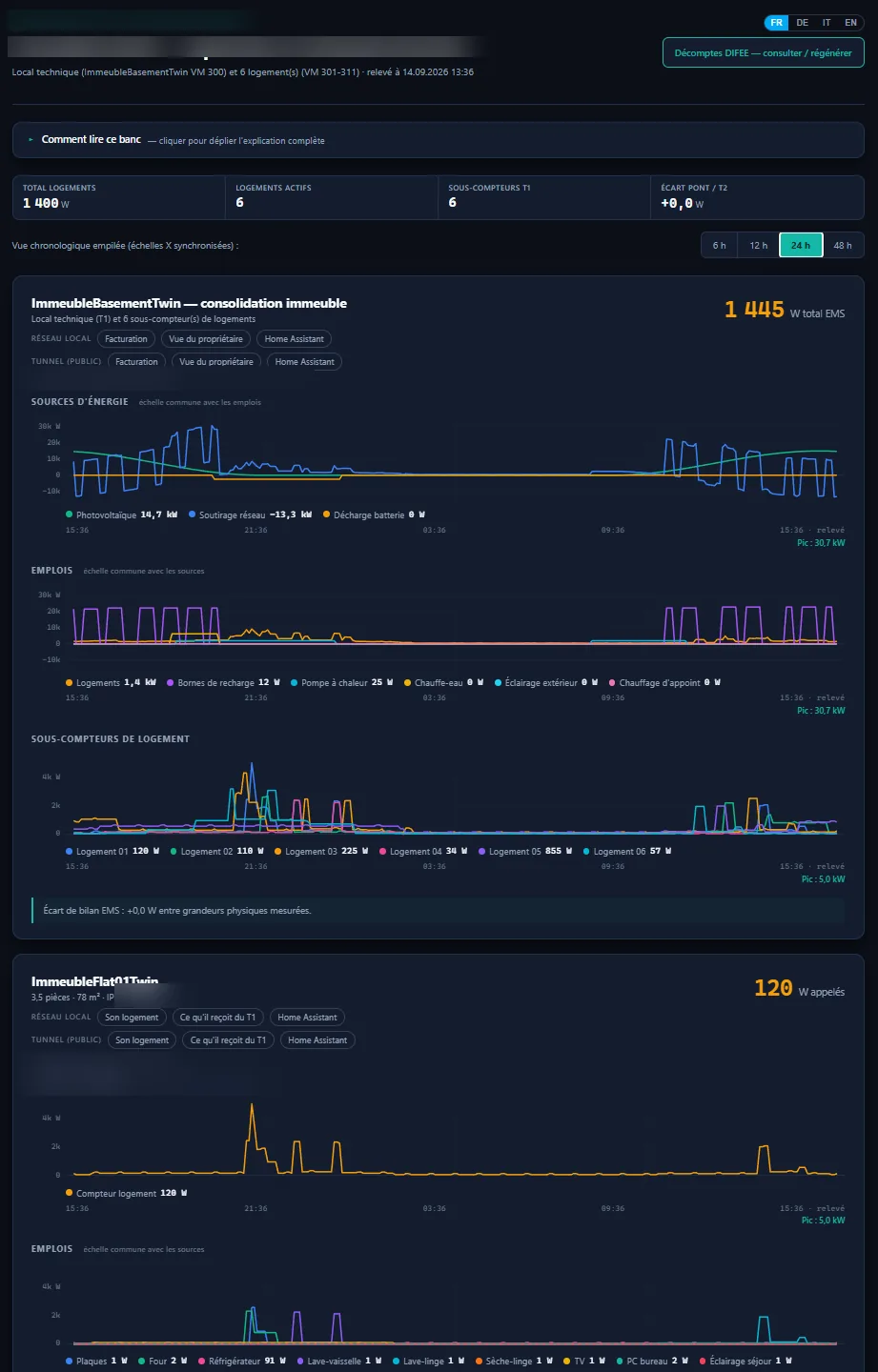
The supervisor of a building on our test bench: building sources and uses, unit sub-meters, then each unit on its own.
07 · The most advanced
Self-consumption groups and local energy communities: sharing energy between neighbours
Swiss law knows three frameworks for sharing local production. They differ by perimeter and by grid tariff, not by technique. For the hub, it is one and the same coordination protocol, with a declared regime.
Self-consumption group: one building, one connection
The self-consumption group: several units behind a single connection point share the roof. The settlement between them is the engine described in the previous section, in production today.
Virtual self-consumption group: several buildings over the local grid
The virtual group: neighbouring buildings share their production through the distribution grid, with a reduced grid tariff. A building already in a self-consumption group can be a single member of a virtual group.
Local electricity community
The widest framework, open since 2026: members of the same grid service area exchange energy, with admission rules and a grid tariff rebate specific to the regime.
How the coordination works
Sharing passively means letting the grid do the sum. Coordinating means acting: when one household exports while another could absorb, the community sees it and votes.
Every fifteen minutes, a coordinator computes what there is to share and proposes an action, for instance absorbing a surplus by charging a car.
Each household votes with its own hub, which first checks that the action is feasible at home. A household whose hub is unavailable abstains: never a yes by default.
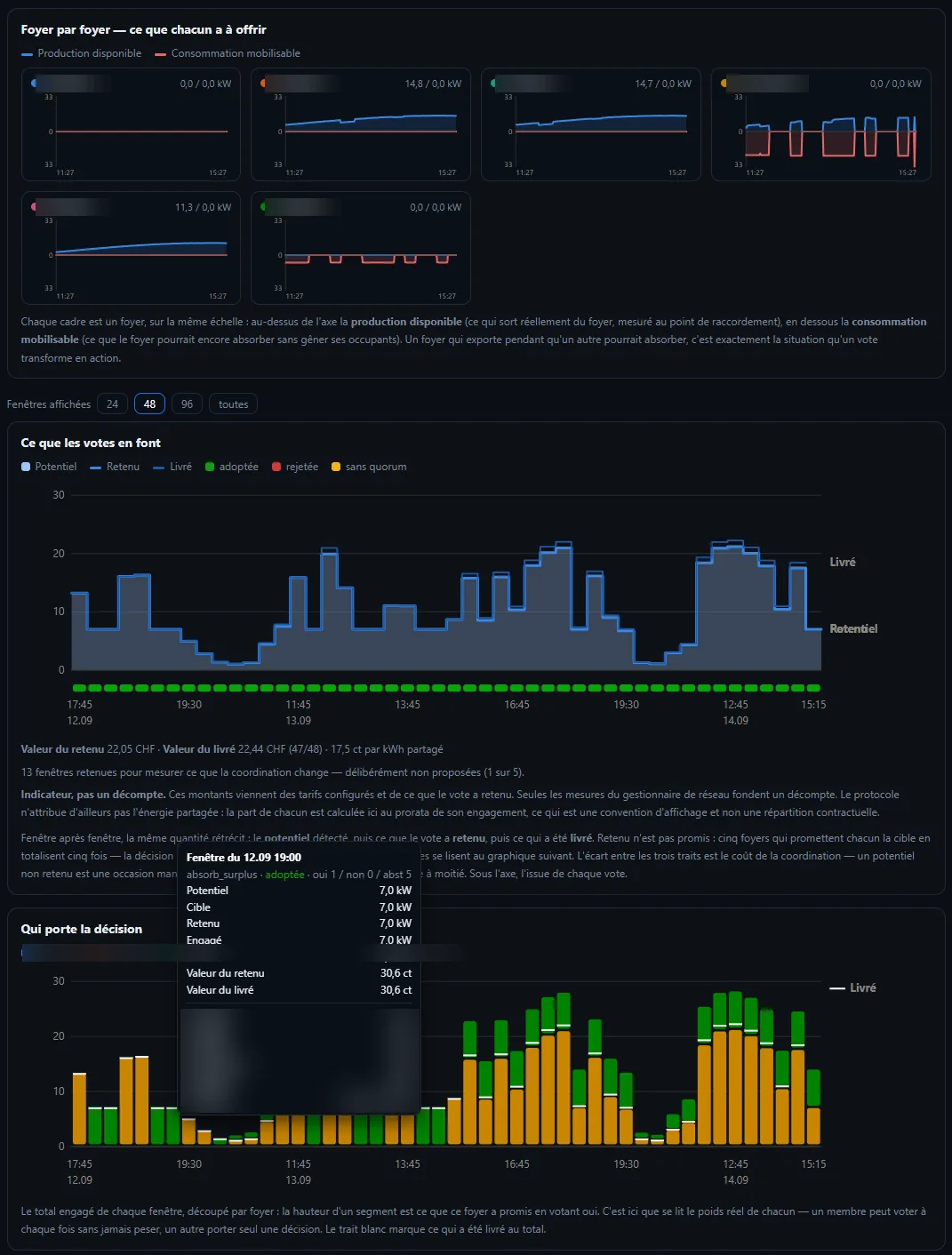
What was promised, retained and actually delivered reads window by window, with its value. The gap between the three is the cost of coordination, and it is shown.
Actual status: cross-building coordination runs on our test bench, five simulated villas and one building, with real control of charging stations. It is a capability in preparation, not yet a delivered product. Settlement within a building, on the other hand, is in production.
The community dashboard on the test bench: what each household has to offer, what the votes make of it, and who carries the decision.
Let us talk about your installation
A villa, a building, a neighbourhood: tell us what is on the roof and in the basement, we will tell you what the hub will do with it, and what it will not.